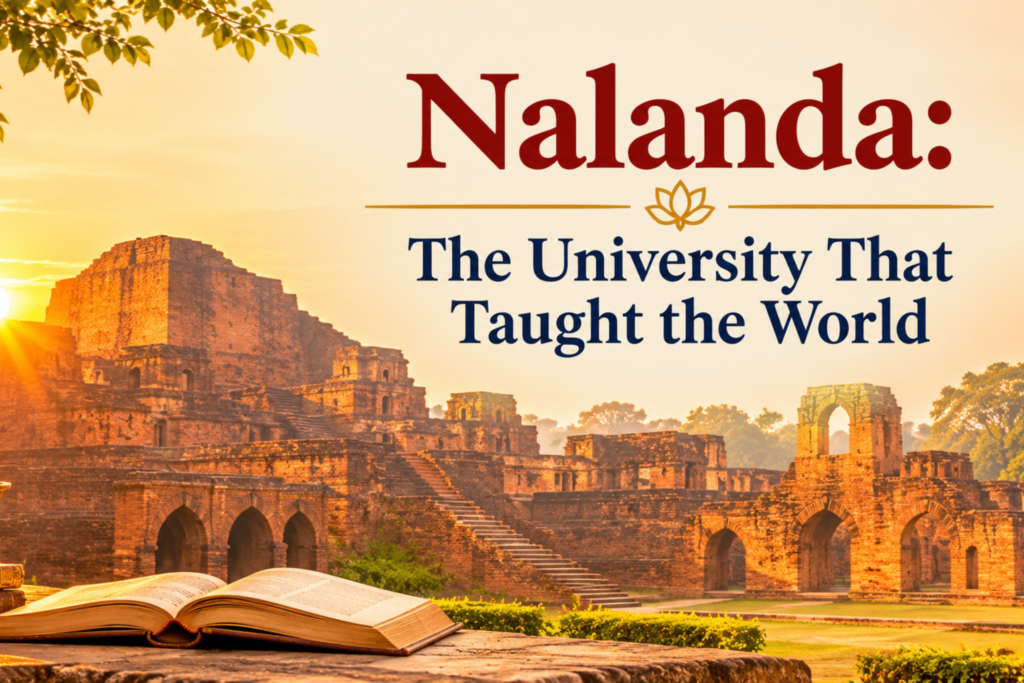

Imagine arriving at a university where the gatekeeper tests you with questions before you are allowed in. Where thousands of students from distant lands live, debate and study side by side. Where a visitor from China spends years learning and then carries home hundreds of manuscripts.
That university existed. It was called Nalanda, and it stood in what is now Bihar, India.
A place where the world came to learn
Nalanda flourished from around the 5th century CE for several hundred years. It was a Buddhist monastic university, but its curriculum was broader than that sounds. Students are recorded as studying logic, grammar, medicine, philosophy, mathematics and astronomy, and many came from beyond India: China, Korea, Tibet, Central and Southeast Asia.
The best-known visitor is the Chinese monk Xuanzang, who travelled to India in the 7th century and studied at Nalanda for years. His accounts describe a large, well-organised community of scholars, a respected teaching tradition, and a library so valuable that it became a reference point for knowledge itself. Another Chinese pilgrim, Yijing, left similar impressions later in the same century.
Accounts tell of thousands of residents, though the exact numbers are estimates from travellers rather than precise records.
What made it special was the culture, not just the buildings
It is easy to be dazzled by scale. What stands out more is how learning seems to have worked.
- Questions mattered. Debate was central. Students were expected to defend ideas, not merely repeat them.
- Knowledge was shared across borders. Scholars from many places learned together and carried ideas home.
- Texts were copied and preserved. The library was a living resource, which meant knowledge could outlive any one teacher.
- Standards were high but the doors were open. Entry was selective, yet the aim was to gather talent from everywhere.
None of this is mysterious. It is a description of a community that took learning seriously and made it a daily habit.
The loss
Nalanda declined over time and was attacked and destroyed toward the end of the 12th century. Later chronicles describe its library burning for a very long time. Historians debate the details of how and why it ended, but the broad result is not in doubt: a great centre of learning was lost, along with manuscripts that can never be replaced.
We do not need to dwell on blame to take the lesson. Knowledge is more fragile than it looks. It depends on people who value it, protect it, copy it and pass it on. When that chain breaks, even a great accumulation of wisdom can vanish within a generation.
Bringing Nalanda into your own life
You probably do not run a university. But you do run a learning culture of one: the habits, environment and attitudes that decide whether you keep growing. Nalanda suggests a few questions.
Do you keep your own “library”? Notes, books, voice memos or a simple journal of what you have learned. If you do not write ideas down, you are relying on memory, which is the most fragile library of all.
Do you ask good questions? Nalanda’s gatekeepers asked before they admitted. Try asking yourself before you take on a new project: what do I actually want to understand here?
Do you learn with others? Nalanda was a community. A reading friend, a study group or a mentor turns learning from a chore into a conversation.
Do you pass things on? Teaching what you know, even to one child, colleague or friend, is how knowledge survives. It also deepens your own understanding.
A real-life picture
Think of a woman who spent years running a household and now wants to start a small business. She does not have a degree in it, but she begins a notebook of lessons from each customer conversation, joins a local women’s group where members swap tips every week, and teaches a neighbour what she has learned about pricing. In a quiet way, that is a Nalanda: curious, collaborative, and committed to keeping what she learns.
Try this week
Choose one small “learning ritual” and keep it for seven days:
- Capture: Write down one new thing you learned each day, in a single sentence.
- Question: Add one question you still have.
- Share: At the end of the week, explain one thing to another person.
At the end of the week, look at your notes. You have just built a tiny library.
Reflection question
If your knowledge disappeared tomorrow, what would you most regret not having written down or passed on?
Closing thought
Nalanda reminds us that wisdom is not guaranteed to last. It survives only when people choose, again and again, to learn, record and share it. The ruins in Bihar are quiet now, but the invitation they carry is not: build a life where curiosity is protected, and let what you know become a lamp for someone else.
What’s one thing you are learning right now? Tell us in the comments.